Watch
Identify the level and the conditions that must happen first.

Synthetic MES 5-minute candles. Times are bar closes in ET.
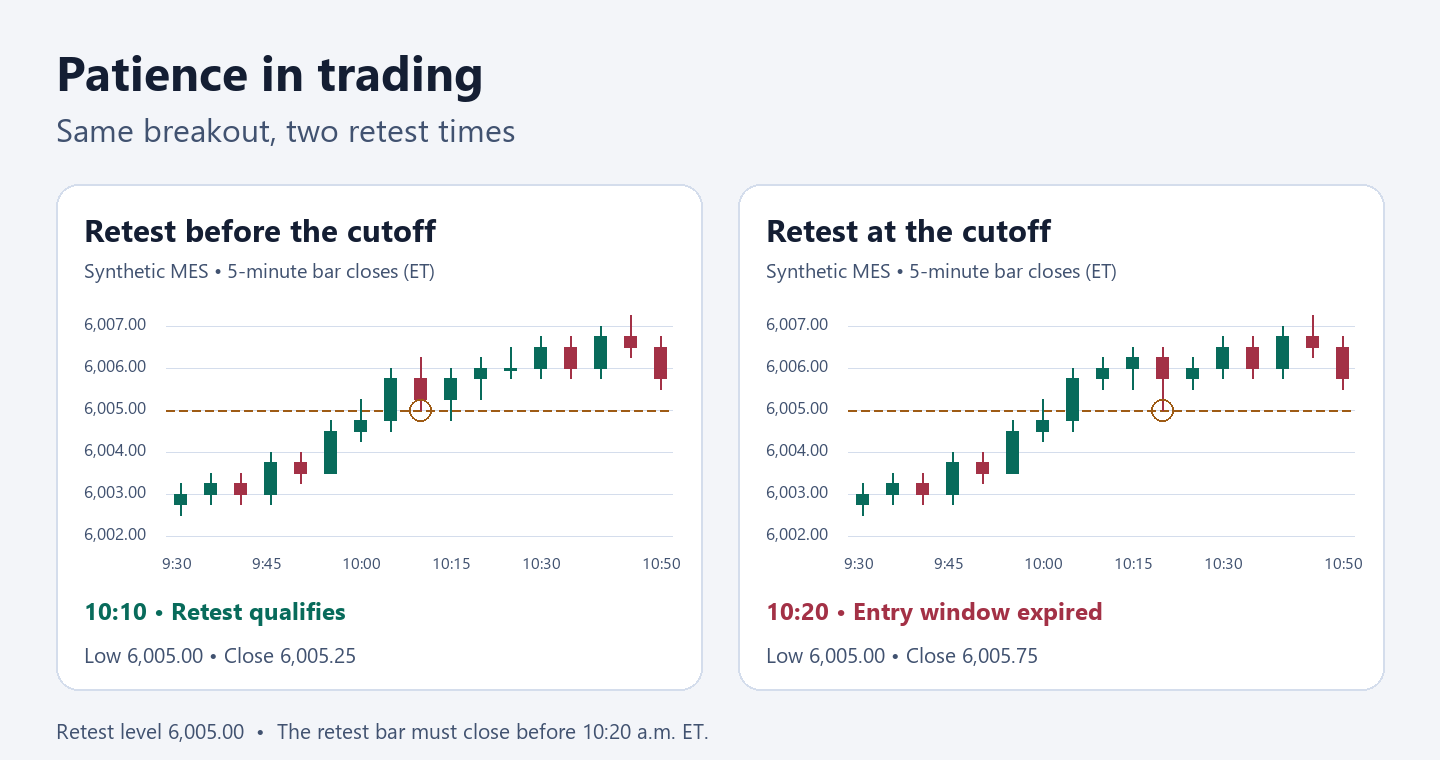
The breakout closes at 10:05 a.m. ET. The 10:10 candle reaches 6,005.00 and closes at 6,005.25, so the retest condition is met before the cutoff.
Identify the level and the conditions that must happen first.
Review the new information at a completed bar close.
Record a pass when the setup expires or risk checks fail.
For this fictional MES exercise, mark 6,005.00 before starting. Wait for a five-minute close strictly above the level. Then wait for a later completed candle with a low at or below 6,005.00 and a close back above it. Only retest candles that close before 10:20 a.m. ET qualify. A retest close is a prompt to check risk and entry price before submitting a simulated order.
A mechanical rule can use those conditions exactly. If you use discretion, record any veto and what evidence would justify it before starting. For example, use a maximum spread from your plan. Where historical quotes are missing, leave that check unknown. Keep entry rules separate from a reminder or alert that only says to look.
At 10:00 the price trades above the line but closes below, so no breakout qualifies. At 10:05 the close qualifies. That candle’s low happened within the same bar, before the close was known, so it cannot supply the later retest.
In the first chart, the 10:10 candle touches 6,005.00 and closes above. The setup is eligible to review while the window is open. In the second, the first valid-looking retest closes exactly at 10:20. The cutoff is exclusive, so the setup has expired. A bar’s high and low supply no proof of an executable quote or fill.
Select No qualifying setup in the chart. At 10:00 a.m. ET an intrabar price alert can fire above 6,005.00, while the bar closes below the level. At 10:05 the close is exactly on the level, so it still fails the strict breakout rule. If boredom makes the wick look good enough, write down which condition you are tempted to change. Return to the written trigger at the next scheduled check.
At 10:20 the window ends with no breakout that qualifies for a retest. Log one watched idea and zero eligible setups. The 10:25 rally belongs in your later observations. If you stopped watching before the cutoff and have incomplete records, mark coverage unknown. Keep practice notes or orders already in progress separate from the decision to send a new entry.
Plan one action for the quiet time while the window is open, such as checking the setup only at the scheduled bar close. At the cutoff, finish the entry review and record whether you followed the plan. That gives you something specific to work on next time even on days with no fills.
Start replay before the level is first touched. After each relevant close, record the time, the unmet or satisfied condition, and your decision. Use a label such as no breakout, awaiting retest, eligible, expired or unknown. Step forward only after making the entry.
Log the times you wanted to act before the trigger, including those when you stayed flat. Keep sessions with no setup in the journal. Count early simulated entries and expired setups taken as rule deviations. A later rally or selloff can help you study the setup, but the earlier waiting decision should use only the facts you had at the time.
Platform details on this page were checked against these official resources.
Distinguish a valid skip from an eligible miss or unfilled order.
Define when new entries are permitted at the session level.
Decide which conditions are objective and where judgment belongs.
Reveal one candle at a time before reviewing the outcome.
Write one setup’s trigger and cutoff, then step through a historical replay. State what you’re waiting for after each relevant close and record the decision before revealing the next candle.
Apply the time convention you set in advance. If the window requires a trigger strictly before the cutoff, a bar closing exactly at the cutoff is too late.
Patience follows a waiting rule while a condition is missing. Hesitation can appear after every condition passes and you know there is an eligible action. Use the quote, clock and order record to distinguish them.
Futures trading contains substantial risk and is not suitable for every investor. TradeReign is a trading-discipline and rule-enforcement application. It does not provide trading advice, trade signals, investment recommendations, or performance guarantees.
TradeReign is not a broker-dealer, futures commission merchant, or investment advisor.
Futures trading contains substantial risk and is not for every investor. An investor could potentially lose all or more than the initial investment. Only risk capital - money that can be lost without jeopardizing financial security or lifestyle - should be used for trading. Past performance is not necessarily indicative of future results.